 Guides · Inverters and solar
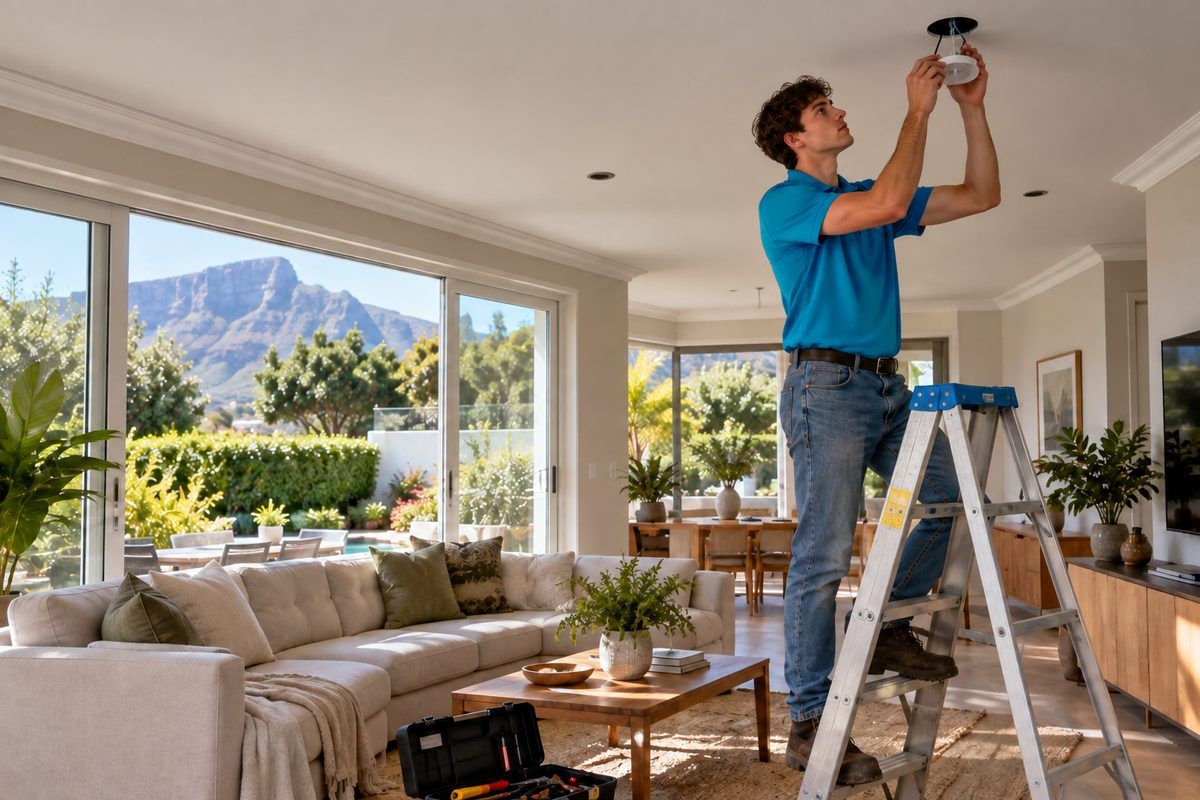
Tokai, Bergvliet and Newlands sit next to each other in the Southern Suburbs, and we work in all three. Wikipedia describes Bergvliet as a large, affluent, tree-lined suburb of mostly large, detached homes, and Newlands as an upmarket suburb at the foot of Table Mountain. For owners of houses like these, an inverter and battery is mostly about keeping lights, fridge, Wi-Fi and security running when the power goes off, and a system wired into the distribution board brings paperwork that the electrical wiring alone does not cover.
What the City asks for
The City of Cape Town requires authorisation for embedded generation. In its own words you are required to apply for authorisation from the City if you intend installing an embedded generation system, and that includes solar with or without batteries, and inverter-and-battery systems on their own. The City issues a Permission to Install letter once an application is submitted. The system may then be installed, but may not be switched on until it has been commissioned and approved.
- Authorised inverters only. The City publishes a list of approved PV inverters, and the inverter must be on it.
- An ECSA-registered professional signs off. For a home, the City allows an ECSA-registered professional technician to certify a residential installation.
- The certificate of compliance is uploaded. The City asks for the electrical installation certificate along with a signed Supplemental Contract once the system is signed off.
- The City then emails a Commissioning Letter. That letter is the document to keep.
Registration is free. The City charges a fee only if you fail to register.
A certificate of compliance is not the same as approval
The City says an installation issued only with a certificate of compliance is not authorised to connect to its network. The electrical certificate shows the wiring is safe. The City's authorisation is a separate step, and a buyer's attorney or agent may ask for both when a house with solar or an inverter is transferred.
Tokai, Bergvliet and Newlands: what to think about on site
- Where the equipment goes. Wikipedia calls Newlands the wettest suburb in South Africa because of its high winter rainfall. That is a reason, in our view, to choose a dry, ventilated spot for the inverter and battery, and to keep the cable runs and board tidy and labelled. We look at the position on the site visit.
- Houses of different ages. Wikipedia notes that Bergvliet was farmland, and that around 1945 many portions of the farm were divided and sold, so the suburb has been built up over time. Whatever the age of your house, an older board may need work before it can feed a backup circuit, so we check what is there before we quote.
- Which circuits stay on. The size of the system follows what you want to keep running, not how large the house is. Our guide to what an inverter and battery cost explains what drives the price.
- Boreholes and pumps. If you have a borehole or pool pump, tell us early, because it changes what the inverter must carry. See our guide to boreholes in Tokai and Constantia.
What happens if a system was never registered
A property with an unregistered system can be issued a contravention notice and a service fee. The City's published steps are to disconnect the system within five working days, provide a certificate of compliance, register within one month and finish authorisation within three months. The City also says that failure to comply could result in your supply being disconnected, and that it will not grant exemptions for retrospective applications. It is far better to find out before a sale than during one.
Selling a house with an inverter
If you are selling in the City of Cape Town, the electrical certificate of compliance is required on transfer, and an inverter or battery wired into the board is part of what is inspected. Our guide to the electrical certificate in Constantia, Tokai and Bergvliet explains what is checked. Keep the City's Commissioning Letter, the certificate of compliance and your installer's paperwork together. Properties in Eskom's supply area need Eskom's consent instead of the City's, so check whose area you are in.
Where we work
We work in Tokai, Bergvliet, Newlands, Constantia, Claremont and across the Southern Suburbs and South Peninsula. For anything that isn't an emergency, WhatsApp us on 074 490 3100 or email enquiries@lightningfast.co.za. Office hours are Monday to Friday 07:30 to 17:30 and Saturday 08:00 to 13:00. We do not have a long list of completed inverter installations to point to, so we would rather say that plainly and show you the written quote and scope first. Our guide to servicing an installed system covers what comes after.
Common questions
Do I have to register an inverter and battery with the City of Cape Town?
Yes, if it is wired into your distribution board. The City treats solar PV with or without batteries, and battery-only inverter systems, as grid-tied, and requires authorisation before the system is switched on. Registering is free. The City charges a fee only if you fail to register.
Is an electrical certificate of compliance enough for my solar system?
No. The City says an installation with only a certificate of compliance is not authorised to connect to its network. It also needs the City's approval and the commissioning sign-off, and the commissioning report is signed by an ECSA-registered professional.
Do you do inverter, battery and solar work in Tokai, Bergvliet and Newlands?
Yes, we do inverter and battery work, and we also install solar panels. We give you a written quote and scope before starting.
I am selling a house with an inverter. What should I have ready?
The City's Commissioning Letter for the system, the certificate of compliance and your installer's paperwork. If you cannot find them, ask your installer first.