 Guides · Solar
Solar geysers are one of the areas we get the most questions on, and for good reason, they're one of the few genuinely effective ways to cut a household's power bill, and few local companies install and service them properly. Here's what's actually involved, and how to think about the cost.
High pressure or low pressure: the first real decision
This is the most important distinction, and it's worth understanding before anything else. A high pressure system works with your existing municipal mains pressure, the same as a normal geyser, and can usually replace an existing electric geyser directly. A low pressure system uses a header tank in the roof and gravity feed, and is typically used where mains pressure is unreliable, or as a retrofit option that's cheaper to install. Which one is right depends on your existing plumbing, your roof space, and your water pressure, not on price alone.
How the installation works
- Site assessment first. Roof orientation, available space, existing pipework and your household's hot water usage all affect what size system makes sense. We size this properly rather than selling you whatever's in stock.
- The panels (collectors) go on the roof, angled and positioned for the best sun exposure, usually north-facing where the roof allows it.
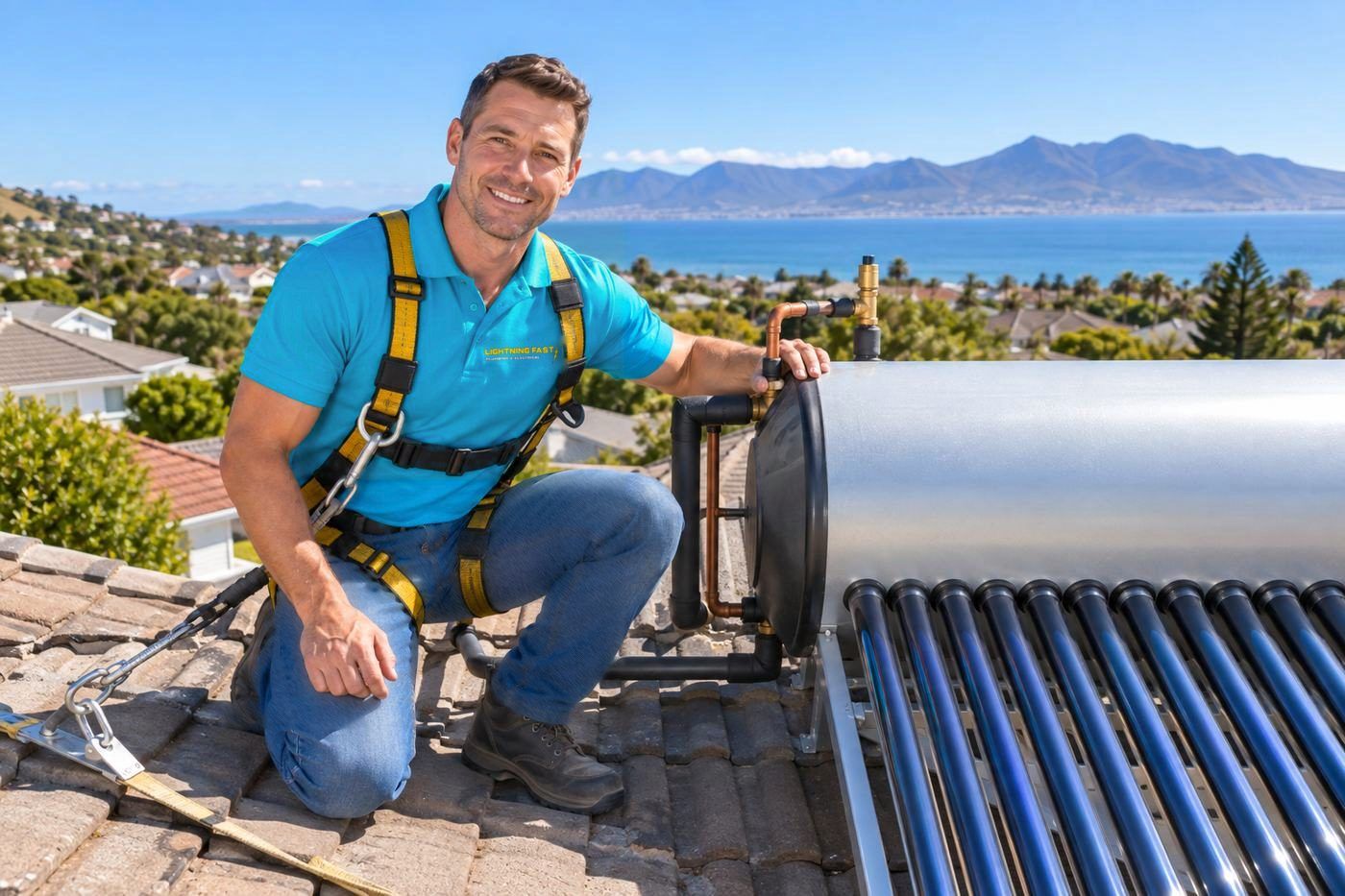
- The tank connects to the collectors, either mounted on the roof alongside them (a close-coupled system) or lower down with the water pumped up (a split system).
- A backup element stays in place, so you still have hot water on an overcast week, the solar system simply reduces how often that element needs to switch on.
- Everything gets signed off to current regulation, the same compliance standard as any geyser installation, so it's covered if you ever sell the property or claim on insurance.
What it typically costs
Solar geyser prices vary by tank size (150 litre and 200 litre are the two most common sizes for a household) and by brand, and installation cost is separate from the unit price. We give a fixed, itemised quote after the site assessment, since roof access, pipe runs and whether you're converting an existing system all affect the real number, a generic online price rarely matches what a proper installation actually costs.
Solar geysers across the Southern Suburbs
We install and service solar geysers throughout the Southern Suburbs, from Constantia and Tokai through to Claremont, Kenilworth and Wynberg. Roof angle and available sun exposure vary a fair amount street to street in this area, which is exactly why a proper site assessment matters more than a one-size-fits-all quote. Down the South Peninsula we cover Muizenberg, Noordhoek, Kommetjie, Simon's Town and Scarborough on the same flat call-out rate.
Common questions
Will a solar geyser work on a cloudy day?
Yes. The backup electric element handles hot water on days without enough sun, you're never without hot water, you're just drawing less power from the grid on sunny days.
Can I convert my existing electric geyser to solar?
In most cases, yes. We assess your existing setup and tell you honestly whether it's a straightforward conversion or whether the geyser needs to be relocated or resized.
How long does installation take?
A straightforward conversion is typically a one-day job. More involved installations, particularly split systems with a longer pipe run, can take longer, we'll tell you which applies once we've seen the site.
Solar geysers in Cape Town's climate
Cape Town has plenty of summer sun, but most of its rain falls in winter, so a solar geyser here needs a properly sized backup for the grey months. The summer south-easter is the other local factor: collectors and frames must be fixed to the roof to withstand it, and in coastal suburbs like Simon's Town, Kommetjie and Scarborough the fixings need to resist salt corrosion as well.
Still weighing up your options? Read how heat pumps compare to solar geysers.